
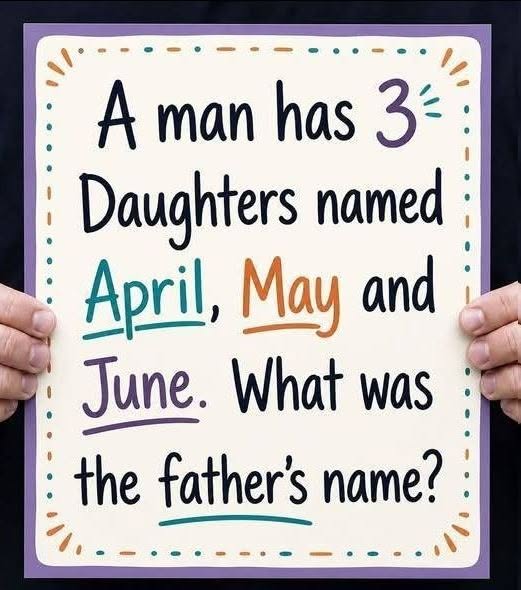
Social media is no stranger to brain teasers, but every once in a while, a riddle comes along that completely divides the comment section. The latest puzzle making the rounds is a deceptively simple wordplay challenge that has thousands of people second-guessing their reading comprehension.Solve Brainteaser Puzzles
The image features a colorful sign with a seemingly straightforward question:
“A man has 3 daughters named April, May and June. What was the father’s name?”
At first glance, it looks like a trick question about the calendar. Many people immediately start guessing other months—is it “July”? Or maybe “August”?
But the real answer lies not in math or calendar trivia, but in basic grammar.
The Clue is in the Punctuation
If you read the riddle out loud, the trick becomes much clearer. The key to solving this puzzle is paying close attention to the phrasing of the very last sentence:
“What was the father’s name?”
Discover more
Explore Gourmet Recipes
Solve Brainteaser Puzzles
Compare Broadband Plans
Read that sentence again. Slowly.Get Language Courses
Now read the first sentence:
“A man has 3 daughters named April, May and June.”
Do you see it?
The question isn’t asking you to figure out the pattern of the daughters’ names and extrapolate the father’s name from a calendar theme. The question is literally asking: What is the father’s name?
And the riddle already told you.
The Answer (Spoiler Alert – Scroll Slowly)
The father’s name is What.
Yes, really.
Let me explain.
The riddle says: “A man has 3 daughters named April, May and June. What was the father’s name?”
The sentence is structured as a statement followed by a question. But if you read it without the question mark, it becomes:
“A man has 3 daughters named April, May and June. What was the father’s name.”
In other words, the father’s name is What.
It’s a grammar joke. A play on words. A riddle that tricks you into searching for a pattern in the daughters’ names (months of the year) while the answer is hiding in plain sight.Get Language Courses
Why This Riddle Goes Viral Every Single Time
see continuation on next page
For Complete Cooking STEPS Please Head On Over To Next Page Or Open button (>)
Why This Riddle Goes Viral Every Single Time
This riddle has been circulating online for years, and it still catches people off guard. Here’s why:
- Pattern recognition is powerful. Our brains are wired to find patterns. When we see April, May, and June — three consecutive months — we immediately assume the riddle is about months. We start searching for the next month (July) or the previous month (March). We don’t consider that the answer might not be a month at all.
- We read too fast. Most people skim the riddle. They see the question mark at the end of the sentence, but they don’t process the actual words of the question. Their brain fills in the gap: “What was the father’s name?” is interpreted as “What is the father’s name?” — an open question. But the word “What” is doing double duty.
- Punctuation is invisible to most readers. We use punctuation automatically. We don’t usually stop to think about how a missing comma or a misplaced period could change the meaning of a sentence. This riddle exploits that blind spot.
- Social media encourages fast, reactive thinking. People scroll, see the riddle, blurt out an answer (July! March! August!), and comment immediately. By the time someone figures out the trick, the comment section is already a war zone.
The Grammar Breakdown (For the Skeptics)
Let me break this down for anyone who still thinks the answer is July.
The riddle is a single sentence:
“A man has 3 daughters named April, May and June. What was the father’s name?”
Normally, this would be a sentence followed by a separate question. But if you remove the period and question mark, it becomes a complete declarative sentence:
“A man has 3 daughters named April, May and June, What was the father’s name.”
In this reading, “What” is not an interrogative pronoun — it’s a proper noun. It’s the father’s name.
The father’s name is What.
His daughters are April, May, and June.
That’s the whole riddle.
How People React to the Answer
I’ve watched this riddle unfold in real-time on social media. The reactions follow a predictable pattern:
Phase 1: Confident Wrong Answers
People post “July!” “March!” “August!” “The father’s name is December!” They are certain. They are smug. They have solved the puzzle.
Phase 2: Confusion and Defensiveness
Someone posts the correct answer (What). Chaos erupts. “That doesn’t make sense!” “That’s not a name!” “This is stupid!” People refuse to believe they were tricked.
Phase 3: Frustration (at the riddle or at themselves)
The grammar clicks. The penny drops. Some people laugh at themselves. Others get angry at the riddle for being “unfair.” (It’s not unfair. It’s clever.)
Phase 4: Acceptance and Sharing
The enlightened ones start sharing the riddle with their friends, determined to trick them the same way they were tricked.
If you’re reading this, you’ve probably just entered Phase 4.
Welcome.
Other Viral Riddles That Use the Same Trick
see continuation on next page
For Complete Cooking STEPS Please Head On Over To Next Page Or Open button (>)
